Search this Site

Showing posts with label Reconnaissance.. Show all posts

GROUND-TO-AIR LASER RECHARGES AIRCRAFT - LaserMotive's laser power system

Lockheed Martin Stalker
Lockheed Martin's recent test of LaserMotive's new laser powering system on the Lockheed Martin's Stalker, a small, silent UAV used by US special forces since 2006, showed that drones of the future might not need to land to be recharged. 

A visual summary of how the system works.
Credits to techcentre.in
In the test, the Stalker was modified for compatibility with LaserMotive's laser recharging system through the installation of special photo voltaic cells on the drone (as you can deduce, the way this system works is very similar to that of solar panels). The Stalker was then placed to fly in a wind tunnel under flight conditions so the laser does not have to constantly track and adjust for the drone's position that would have been necessary if it was actually in fight. Results were overwhelmingly positive as the drone seemed to be able to stay in flight indefinitely with the battery power being higher than when the test started. The test team only stopped at 48 hours because it was already greatly passed their originally set endurance goals. Without the laser power system, the Stalker's battery can only last a maximum of 2 hours. 

Although this tremendous rate of power transfer by LaserMotive's wireless recharging systems will be a huge step forward for electric aircraft flight endurance and wireless recharging technology overall, it definitely isn't good news for birds everywhere. 

Aerial Intelligence - The LEMV Modern Blimp

The US military gave Northrop Grumman a $ 517 million contract to create an LEMV or Long Endurance Multi-intelligence Vehicle. The LEMV is basically a giant airship that will provide long term aerial reconnaissance and surveillance support for ground troops.

The LEMV is a 300 ft. long behemoth that, like many of the new aircraft being developed, will be unmanned. It can stay aloft in the air for up to three weeks at a time and has a low pressure helium hull. However, what's really incredible of the LEMV is that its aerodynamic hull accounts for 40% of its lift. As a result, the hull does not need a lot of helium to keep it in the airship in the air and so, when the fragile surface of the hull is somehow punctured or shot, the airship will not explode or fall out of the sky.

The LEMV will be powered by four diesel engines and will cost $15 000 per re-fuel for every three-week mission. This is amazingly one-tenth of the price of fuel used for a helicopter and one-quarter of the price of fuel used for an airplane per mission.

The LEMV is set to be finished and operational in the latter half of this year. It will be used for a demonstration mission in Afghanistan and upon success of the missile, five more will be built.

Hand-launched UAV - The RQ-11B Raven


Since production of the AeroVironment RQ-11B Raven began in 2004, more than 13 000 units have been built. These small hand-launched remote-controlled unmanned aerial vehicle or SUAV were originally developed for the US military but have now been adopted by several other countries.

The Raven is now widely used by the US military for reconnaissance, scouting, surveillance, and target acquisition purposes both day and night. It can fly for about 60-90 minutes in an operational radius of 10 km (6 miles). The Raven can either be remote-controlled from the ground or fly autonomous missions using GPS waypoint navigation. Its small 1.9 kg (4.2 pounds) airframe usually harnesses CCD color video cameras and infrared night vision camera. The aircraft is powered by a small propeller located at the back of the wings.

Landing for the RQ-11B is not a problem as it can automatically fly itself to a predetermined landing point and perform a near vertical (1 foot down, 1 foot forward) "Autoland" descent. If its wings snap or break off on landing, a new one can easily be attached.

Panavia Tornado

The Panavia Tornado was the result of the joint effort of the UK, Germany, and Italy. A multirole fighter, the Tornado has three primary versions, the Tornado IDS fighter bomber, the Tornado ECR electronic warfare fighter (suppresses enemy air defenses), and the Tornado ADV interceptor. In total, 992 Tornadoes were built for the RAF, the Luftwaffe, Italian Air Force, and the Royal Saudi Air Force.

Overview...

The Tornado was intended as a low-level supersonic bomber that can operate in high and low speeds. However, planes that are maneuverable in high speeds tend to have poor low-speed performance and vice versa. To counter this dilemma, Panavia decided that a variable wing sweep design will be the ideal feature for the plane. The variable wing sweep design works like this: the wings of the plane go fully swept when the plane is flying at high speeds and return to its original position in slower speeds. This fulfills the requirement that the Tornado performs well in high and low speeds.
The Tornado is also designed to operate on short runways. Since it is a land-based aircraft that has to operate on large airfields that are vulnerable to air attack, the Tornado is required to be able to land and takeoff in short distances. This criteria is fulfilled with the Tornado's variable wing sweep design, which when extended fully forward, creates enough lift to lower the minimum landing and takeoff speeds, thus allowing the Panavia Tornado to operate on short runways.
Variants...

  1. Tornado IDS
  • The Tornado IDS variants were the strike aircraft version of the Tornado. This variant was designed for ultra-low-level penetration strikes of Warsaw Pact targets and is equipped with a terrain following radar that allowed hands-off all weather low-level flight. Additionally, it is equipped with a Laser Range Finder and Marked Target Seeker (LRMTS) for improved bombing accuracy. The LRMTS can also receive reflected laser energy from a third party laser, which allows the bomber to lock on targets laser-marked by other friendly units.
  • The Tornado IDS has 4 different versions, the GR1, GR1B, GR4, and GR1A/GR4A.
  1. Tornado ECR
  • The Tornado ECR is what you would call a "Wild Weasel", which is an aircraft that takes out enemy surface-to-air defenses and their radars, basically all enemy electronics used to detect friendly planes. This version is equipped with the emitter-locator system (ELS) which locates enemy radar positions and armed with the AGM-88 HARM (High-speed Anti-Radiation Missile) to take the radars out.
  • The performance is similar to the Tornado IDS.
  1. Tornado ADV

  • The Tornado ADV is the fighter version of the Tornado. It has a greater sweep angle on the inboard fixed winged sections for greater performance in different speeds. The ADV also has an extended radome to fit the Marconi Ferranti Al.24 Foxhunter airborne interception radar. The fuselage is stretched by 1.36m to accommodate the four Skyflash semi-active radar homing missiles and a plug has been added immediately aft of the fuselage with the added benefits of reducing drag and making space for an extra fuel tank. Finally, the port (left) cannon has been removed.
  • The ADV has two versions, the F2 and F3.
Specifications...

General characteristics (Panavia Tornado F3)

  • Crew: 2
  • Length: 18.7 m (61.3 ft)
  • Wingspan: (Variable geometry wing)
    • At 25° wing position : 13.91 m (45.6 ft)
    • At 67° wing position: 8.60 m (28.2 ft)
  • Height: 5.95 m (19.5 ft)
  • Wing area: 26.6 m² (286 sq ft)
  • Empty weight: 14,500 kg (32,000 lb)
  • Loaded weight: 21,546 kg (47,500 lb)
  • Max takeoff weight: 28,000 kg (61,700 lb)
  • Powerplant: 2× Turbo-Union RB199-34R Augmented Turbofans
    • Dry thrust: 40.5 kN (9,104 lbf) each
    • Thrust with afterburner: 73 kN (16,410 lbf) each

Performance

  • Maximum speed: 800 knots IAS (1,452 mph, Mach 2.27, 2,338 km/h)
  • Range: 755 nmi (869 mi, 1,390 km)
  • Ferry range: 2,300 nmi (2,650 mi, 4,265 km) with four external tanks
  • Service ceiling: 15,240 m (50,000 ft)
  • Thrust/weight: 0.56

Armament

  • Guns: 1× internal Mauser BK-27 with 180 rounds (versus 2× BK-27 mounted on Panavia Tornado IDS)
  • Hardpoints: 10 total (4× semi-recessed under-fuselage, 2× under-fuselage, 4× swivelling under-wing) holding up to 9000 kg (19,800 lb) of payload, the two inner wing pylons have shoulder launch rails for 2× Short-Range AAM (SRAAM) each
  • Rockets: None
  • Missiles:
    • Air-to-air missiles:
      • 4× AIM-9 Sidewinder or AIM-132 ASRAAM
      • 4× British Aerospace Skyflash or AIM-120 AMRAAM (mounted on 4 semi-recessed under-fuselage hardpoints)
  • Bombs: None
  • Others:
    • Up to 2× drop tanks for extended range/loitering time. Up to 4 drop tanks for ferry role (at the expense of 4 Skyflash/AMRAAM).

Avionics

  • Marconi/Ferranti AI.24 Foxhunter radar

The Bronco

In the 1960's, when the war in Vietnam was in full swing, there emerged an aircraft that was quite unspectacular compared to the supersonic jets of the era like the F-4 Phantom and the F-100. However, the slow and sturdy plane would prove in the long run, just as useful. It is the OV-10 Bronco.

The Bronco was contrived by two Marine Corps Majors, K.P. Rice and William H. Beckett, who realized that with the Navy and Airforce preoccupied with slick, swept-winged jets, the conventional weapons necessary for the close air support of ground forces were forgotten. Thus, they decided to create a plane that will fill in that role, and the Bronco was born. The plane envisioned by the two was a sturdy observation plane that could also attack enemy forces on the spot. It was twin-engined and was capable not only of taking off and landing on short runways but on runways in adverse conditions.

The Bronco was used as a Forward Air Controller (FAC), that calls in artillery, fighter-bombers, or naval gun support to eliminate enemy threats to friendly ground forces. It can also call in Medevacs or helicopters to evacuate ground forces in tight situations.


Armament...

The Bronco has 4 machine guns attached to sponsons under the fuselage and a centerline station for a 20 mm cannon. The OV-10 can also carry up to 2 400 more pounds of explosives such as rockets, missiles, and bombs on the sponsons.

Besides bombs and guns, the Bronco can carry up to 4 paratroopers into battle or injured personnel out.

Weaknesses...

The Bronco, however, had its weaknesses. It lacker power and was vulnerable to groundfire because it often flew at a low altitude and was quite slow.

Into the modern battlefield...

The Bronco continued to be in service until after Operation Desert Storm when the Marine Corps decided to retire it due its slow speed, making it highly vulnerable to anti-aircraft fire. Of the 20 sent in Iraq, 2 were shot down.
Right now, Boeing is working on a newer, modernized version of the Bronco. Although the airframe will not change a lot, the Bronco will have a fully computerized cockpit and will be able to carry newer armament. The centline 20 mm machine gun, for example, will be upgraded to a 30 mm cannon.

Specifications...

OV-10A

Data from Mesko

General characteristics

  • Crew: 2
  • Length: 41 ft 7 in (12.67 m)
  • Wingspan: 40 ft 0 in (12.19 m)
  • Height: 15 ft 2 in (4.62 m)
  • Wing area: 290.95 ft² (27.03 m²)
  • Empty weight: 6,893 lb (3,127 kg)
  • Max takeoff weight: 14,444 lb (6,552 kg)
  • Powerplant: 2× Garrett T76-G-410/412 turboprop, 715 hp (533 kW) each

Performance

  • Maximum speed: 281 mph (452 km/h)
  • Range: 576 mi (927 km)
  • Service ceiling: 24,000 ft (7,315 m)

Armament

  • Guns: 4 × 7.62x51mm M60C machine guns
  • Total stores stations: 5 fuselage and 2 underwing
  • Bombs: Bombs up to 500 lb
  • Rockets: 7- or 19-tube launchers for 2.75" FFARs or 2- or 4-tube launchers for 5" FFARs
  • Missiles: AIM-9 Sidewinder (Wing pylons only)
  • Other: SUU-11/A or Mk 4 Mod 0 gun pods

OV-10D

Data from Mesko

General characteristics

  • Crew: 2
  • Length: 44 ft 0 in (13.41 m)
  • Wingspan: 40 ft 0 in (12.19 m)
  • Height: 15 ft 2 in (4.62 m)
  • Wing area: 290.95 ft² (27.03 m²)
  • Empty weight: 6,893 lb (3,127 kg)
  • Loaded weight: 9,908 lb (4,494 kg)
  • Max takeoff weight: 14,444 lb (6,552 kg)
  • Powerplant: 2× Garrett T76-G-420/421 turboprop, 1,040 hp (775.5 kW) each
  • *Tailplane Span 14 ft, 7 in (4.45 m)

Performance

  • Maximum speed: 288 mph (463 km/h)
  • Range: 1,382 mi (2,224 km)
  • Service ceiling: 30,000 ft (9,159 m)

Armament

  • Guns: 1x 20 mm (.79 in) M197 cannon (YOV-10D) or 4x 7.62x51mm M60C machine guns (OV-10D/D+)
  • Total stores stations: 5 fuselage (OV-10D/D+ only) and 2 underwing
  • Bombs: Bombs up to 500 lb (227 kg)
  • Rockets: 7- or 19-tube launchers for 2.75" FFARs/2.75" WAFARs or 2- or 4-tube launchers for 5" FFARs or WAFARs
  • Missiles: AIM-9 Sidewinder (Wing pylons only)

Ever heard of the Boeing/Sikorsky RAH-66 Comanche?


The Boeing/Sikorsky RAH-66 Comanche. Note the slender body of this helicopter, which is to prevent, or lessen the possibility of detection, either by radar, or human eyes. There is a chance that this is in West Palm Beach, Florida, as the Comanche's first flight took place there. (No date, location, or elaborate description available. I apologize for any inconvenience caused.) http://forums.pelicanparts.com/showthread.php?t=158658&page=12


The Boeing/Sikorsky RAH-66 Comanche, first flew on January 4th, 1996, was the most rigorously tested, and evaluated helicopter, and it was also the best in the World. Highly maneuverable, the Comanche was intended not as to replace the Hughes Helicopters AH-64 Apache, but play a complimentary role, as a Reconnaissance chopper. However, it does carry light weapons too, obviously for self-defense, and not to carry assaults like the Apache.

Development...

The Comanche was developed due to the demand of a dedicated Reconnaissance chopper that is much more efficient than the one the United States Army already uses, which is the Bell Helicopter Textron OH-58D Kiowa Warrior. The Warrior, only an upgrade version of an observation helicopter of the 1970's, was highly vulnerable, and can be easily detected with radar, or just the naked eye. The Army needed something better. That is the reason why this chopper went on the drawing board, and on January 4th, 1996, the first prototype flew in the air.
The Army had planned to purchase about one thousand, and three hundred RAH-66 Comanches to fill both the Reconnaissance, and Light Attack roles, with the first being operational in 2004. However, it was canceled in favour of Unmanned Aerial Vehicles, which have already proven themselves in Afghanistan, and Iraq. The cancellation date was February 23rd, 2004. The other reason for its cancellation was the United States Army needed money to repair or improve its aging fleet of helicopters, but by the time the Comanche program was canceled, a total of US $8, oo0, 000, 000 had been spent on it.


One the two Boeing/Sikorsky RAH-66 Comanche prototypes. Probably "the DUKE", or 94-0327. There is a high chance this is in West Palm Beach, Florida, as the first flight of the Comanche took place there. (No date, location, or elaborate description available. I apologize for any inconvenience caused.)
http://www.redstone.army.mil/history/aviation/aircraft/rah-66.jpg

The two only prototypes of the Boeing/Sik
orsky RAH-66 Comanche ever built is now in United States Army Aviation Museum located at Fort Tucker.

Design...

The Boeing/Sikorsky RAH-66 Comanche, intended to be a scout helicopter, is designed to avoid detection as much as possible, as well as be extremely agile. The airframe of the Comanche is state-of-the-art, able to sustain huge strains in maneuvers unimaginable to experienced helicopter pilots. It also has radar-absorbent materials, which reduces even more, its already low radar signature. Reducing even further the chance of being detected is its relatively low engine sound, and infrared signature. Its weapons system, and avionics, present in the newest, and deadliest variant of the Apache Attack Helicopter, the Apache Longbow, while make the enemy quiver, wherever he is.

Specifications. Wikipedia.

General Characteristics...

Crew: 2.
Length: 46.85 ft (14.28 m.).
Rotor diameter: 39.04 ft (11.90 m.).
Height: 11.06 ft (3.37 m.).
Disc area: 1,197 sq ft (111 sq m.).
Empty weight: 8,690 lb (3,942 kg.).
Loaded weight: 10,597 lb (4,806 kg.).
Max takeoff weight: 17,175 lb (7,790 kg.).
Powerplant: 2× LHTEC T800 turboshafts, 1,432 hp (1,068 kW.) each.
Fuselage length: 43.31 ft (13.20 m.).
Rotor systems: 5 blades on main rotor.

Performance...

Maximum speed: 175 knots (201 mph, 324 km/h.).
Cruise speed: 165 kt (190 mph, 306 km/h.).
Range: 262 nmi (302 mi, 485 km.) (internal fuel.).
Service ceiling: 14,980 ft (4,566 m.).
Rate of climb: 1,418 ft/min (7.20 m/s.).

Armament...

1× 20 mm XM301 three-barrel cannon mounted in a Turreted Gun System (500 round capacity.).
Internal bays: 6 Hellfires or 6 Stingers (ATAS.).
Optional stub wings: 8 Hellfire, 16 Stinger or 56 x Hydra 70 2.75 in (70 mm.) air-to-ground rockets.

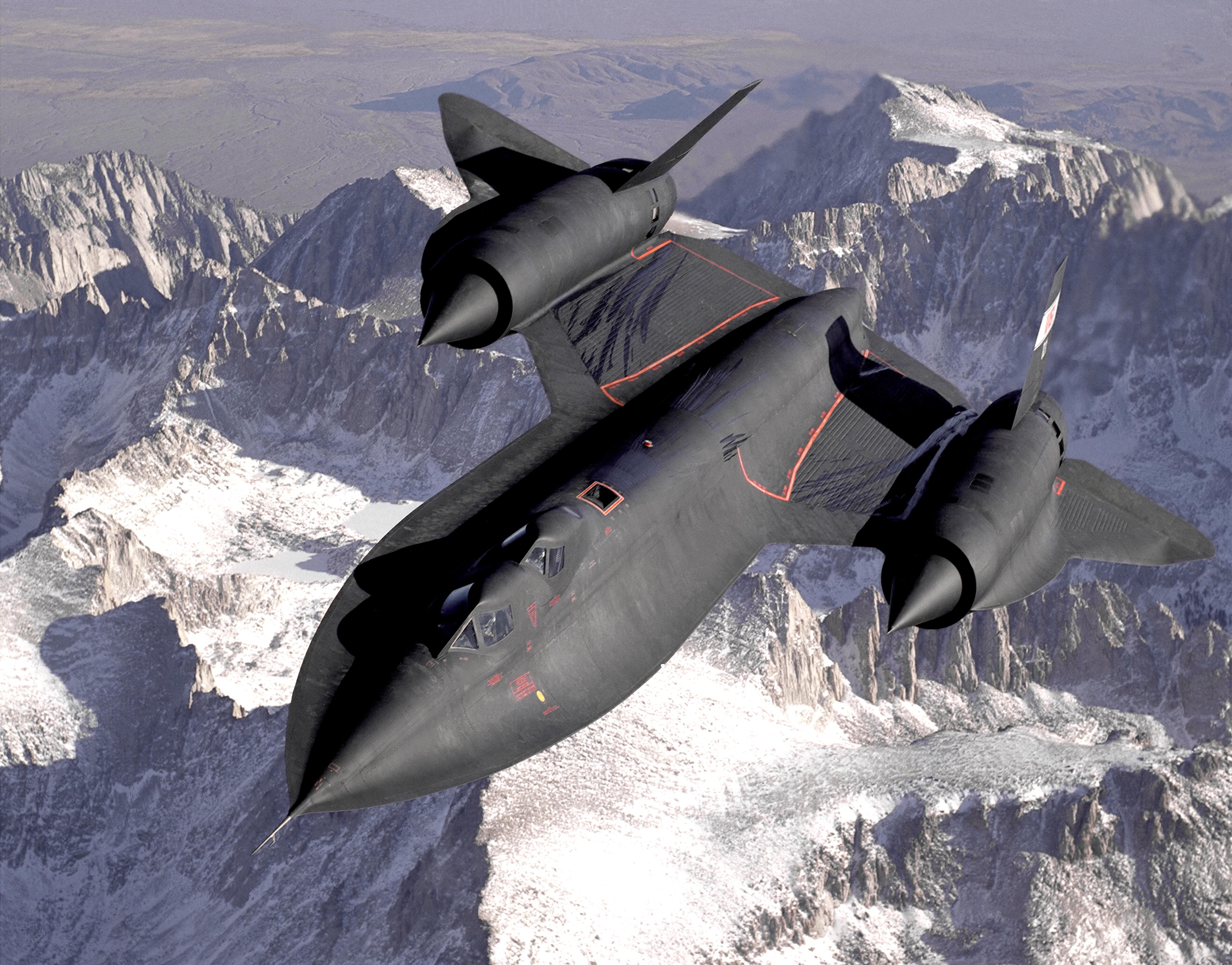
Lockheed Skunk Works SR-71 Blackbird

The SR-71B Blackbird, a trainer version of the SR-71. Note the dual cockpit to allow the instructor to fly the plane.

The SR-71 Blackbird is currently the 2nd fastest plane in the world, next to it's predecessor, the A-12, which can reach speeds up to 3.35, while it is only capable of reaching Mach 3.2+. It was Designed by Clarence 'Kelly' Johnson and produced by Lockheed Skunk Works, and flies at the edge of Space doing reconnaissance missions over Russia during the Cold War. Due to its high speed and amazing altitude, it could easily evade surface-air missiles (SAM). As a result, no Blackbird was lost to enemy action, though 12 of the 32 were lost in accidents. The Blackbird had been so effective that it was brought back out of retirement in the 1990's but was permanently retired in 1998.

The secret of the SR-71's high speed lies in its engines, and material used for its structure. Of course, they do not come cheap military wise. The Pratt & Whitney J58-P4 engine used on the Blackbird was the only military engine designed to operate continuously on afterburner. Also, incredibly, the J58 engine became more efficient when air speed increases, whereas conventional jet engines loses efficiency as the plane speeds up.

When the Blackbird reaches Mach 3, the friction between its surface and the air is so much that the heat generated could actually melt the surface of the aircraft. That is not the case when 85% of the surface of the Blackbird is made of titanium, while 15% of it is made of composite materials. This was a first in the airplane industry. The setback of using titanium is that is was extremely scarce, and very expensive. Additionally, much of the titanium sent to Lockheed to make the Blackbird was imported from the Soviet Union. Making it worse, 80% of the titanium initially delivered to Lockheed had to be rejected due to metallurgical contamination.

...

Contact

mailwebaviation@gmail.com
Search & Win