Search this Site

Showing posts with label Historical Events.. Show all posts

Surviving a 33 000 ft. fall without a parachute!


Vesna Vulovic, a former Serbian flight attendant, survived a 33 000 ft. fall on January 26, 1972, without a parachute when a bomb blew up a DC-9 of Yugoslavia's JAT airline (JAT Flight 364). Vesna was 22-years old. She currently holds the world record, according to the Guinness Book of Records, for surviving the highest fall without a parachute. It was exactly 10 160 m (33 333 feet).

The Crash...

The bomb, planted by the terrorist group Ustashe, detonated over the city of Srbska-Kamenica. The DC-9, which had 28 passengers on board, was torn apart by the explosions and the wreckage fell through the air for about three minutes before landing on a snow covered mountain side.

How she survived...

The snow apparently softened the impact and lucky Vesna recieved immediate aid by a German named Bruno Henke. Even better, her rescuer was a World War II medic!

Also, another factor that possibly aided in her survival was her low blood pressure which caused her to pass out quickly and saved her heart from bursting.

Injuries...

At the hospital, the doctors concluded that Vesna had:
  • broken both her legs
  • broken her skull (which was also hemorrhaging)
  • three crushed vertebrae (sections of backbone
Vesna was paralyzed from the waist down and she could not remember anything about the incident and everything one month after - due to amnesia.

Aftermath...

However, movement of both a Vesna's legs were restored with a little bit of surgery and patience. By September of the same year, she was fit for work and was given a desk job at the same airline company (apparently to avoid publicity).

Interesting Facts...
  • Vesna was not supposed to be on the flight. Her schedule was mixed up with another stewardess with the same name.
  • The first thing Vesna asked for when she came to was a cigarette.

Vesna Vulovic

This article was created with information from Damn Interesting

EDIT: so apparently there is a chance (emphasis on chance) this might have been a fabricated story to cover up a mistake. Two investigative journalists from Prague claims that the plane Vulovic was on might have been mistaken for an enemy plane by a fighter plane from the Czechoslovakian Air Force and the shot down plane fell and broke up at a much lower altitude than previously claimed. Guardian

Six times the Speed of Sound?


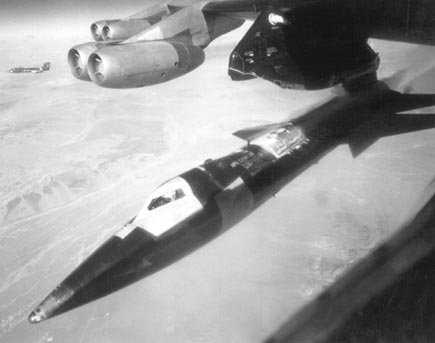
The North American X-15 (first flight: June 8, 1959, last flight: October 24, 1968) was a manned rocket-powered aircraft that broke record after record in the 1960's, flying at astonishing altitudes (328 084 ft) and hypersonic speeds (Mach 6.72). Mach 6.72 is actually 6.72 times the speed of sound!

The X-15 was part of the X-series of experimental aircraft, which the Bell X-1 was part of.

In the end, three X-15's were built and they flew a total of 199 flights (12 pilots):
  • X-15A-1 - 56-6670, 82 powered flights
  • X-15A-2 - 56-6671, 53 powered flights
  • X-15A-3 - 56-6672, 64 powered flights

How the plane was launched...

The X-15 did not launch from a runway. Instead, it was attached to a wing pylon on a specially designed B-52 that brought it to 45 000 feet where the plane was released. The B-52 was designated NB-52 and appropriately called the "mothership".

Two NB-52's were built, NB-52A ( (52-003) and NB-52B (52-008).

Accidents...

Of the three X-15's that were built, planes number 2 and 3 were destroyed in accidents (number 2 was repaired but never flew again). The pilot of the first accident (plane number 2), Jack McKay, survived the crash but was an inch shorter when he was pulled out from under the plane. Unfortunately, the pilot of the second accident (plane number 3), Mike Adams, was killed.

Record Breaking Flights...

  • Joseph Albert Walker broke the highest altitude record of the time three times, his last on August 22, 1963. He reached 328 084 ft on his X-15.
  • William J. "Pete" Knight broke the fastest speed record then on October 3, 1967. Knight reached a top speed of Mach 6.72 (6.72 times the speed of sound).
However, the records set by the X-15 have been broken today by new and more advanced planes.

Planes of the X-15 program on display...

  • X-15A-1 is on display in the National Air and Space Museum "Milestones of Flight" gallery
  • X-15A-2 is on display in the National Museum of the United States Air Force's Research and Development hanger alongside other "X-planes"
  • NB-52A is on display in the Pima Air and Space Museum
  • NB-52B is at the Dryden Flight Research Center

Interesting Facts...

  • Neil Armstrong (first person to set foot on the moon) was one of the X-15 pilots
  • The planned 200th flight of the X-15, piloted by William J. Knight was delayed six times due to technical problems and bad weather. It was eventually cancelled

Specifications...


General characteristics

  • Crew: one

  • Length: 50 ft 9 in (15.45 m)

  • Wingspan: 22 ft 4 in (6.8 m)

  • Height: 13 ft 6 in (4.12 m)

  • Wing area: 200 ft² (18.6 m²)

  • Empty weight: 14,600 lb (6,620 kg)

  • Loaded weight: 34,000 lb (15,420 kg)

  • Max takeoff weight: 34,000 lb (15,420 kg)

  • Powerplant: Thiokol XLR99-RM-2 liquid-fuel rocket engine, 70,400 lbf at 30 km (313 kN)

Performance

  • Maximum speed: Mach 6.72 (4,520 mph / 7,274 km/h)

  • Range: 280 mi (450 km)

  • Service ceiling: 67 mi (354,330 ft / 108 km)

  • Rate of climb: 60,000 ft/min (18,288 m/min)

  • Wing loading: 170 lb/ft² (829 kg/m²)

  • Thrust/weight: 2.07

This article was created with information from AcePilots

MiG Alley

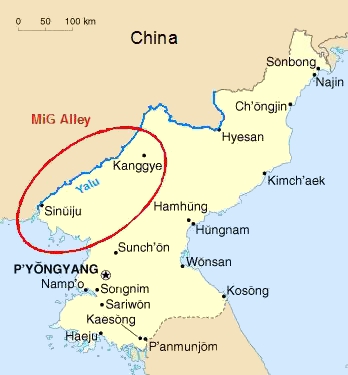
Mig Alley, a name given by U.S. Air Force pilots to the Northwestern portion of North Korea, where the Yalu River empties into the Yellow Sea. As it was the site of the first few large-scale jet-vs-jet air battles, the alley is considered the birthplace of jet combat. It is quite easy to tell that that area of the sky is where the most dogfights occured between MiG-15s, and F-86 Sabres, during the Korean War.

A map showing the approximate location of MiG Alley. Wikipedia

During that time period, in which the war between the two Koreas falls in, MiG-15 were the most commonly used jet fighters by the North Koreans, and their Soviet supporters, and the F-86 Sabre for the South, with their U.S. supporters. However, the first contact in the air between the South, and the North did not involve Sabres, but P-80 Shooting Stars. It occured on November 8th, 1950, when inexperienced Soviet pilots in MiG-15s attacked a flight of equally inexperienced U.S.A.F. pilots. At that time, not a single U.S. squadron based at South Korea had the, at that time, new, and sophisticated, swept-wing F-86 Sabre. As a result, the 4th Fighter Interceptor Wing, which was equipped with Sabres, was rushed to Korea, and Fighter Command had them based at Kimpo Airfield.

Secrecy of their Participation...

The Soviets have long denied the participation of their fighter pilots in the Korean War, but truth is, they were there. Only after the Cold War, when the Soviet party fell, did the pilots start to reveal their role in the fight. It was not a great shock, almost everyone had already made that conclusion themselves, with the proof of the pilots or not.

Large-Scale Daylight Bombing, and the MiG interceptors...

The U.S. was constantly sending large-scale daylight bombing raids on North Korea, and the Soviet forces' primary mission was to intercept, and shoot down the lumbering B-29s. They were very effective. B-29 loses mounted, with the daylight raids becoming a rarity, and night raids had also started to posed risk. Not long after, the MiG-15s also began systematic attacks on U.S. jet fighter-bombers, which were the backbone of the U.S. effort to interdict railway operations in the North. The reason for the Soviets' effectiveness was probably because their decision to withdraw their inexperienced student pilots, and plac combat veterans from World War II, most of them flight instructors, to the fight. The young, and fresh U.S.A.F. pilots, were in-turn at a huge disadvantage, outnumbered, and outskilled. However, this was not the case throughout the whole war. Inexperienced they might have been, they still learned fast.

The standard U.S. fighter formation during the Korean War was the "finger-four", named after its resemblance of the fingers of the right hand, seen from above. It was led by a flight leader, often the most experienced of the four, in the "middle finger", or number one position. He was covered by his wingman, commonly a less experienced pilot that flew on his left, in the "index-finger", or number two position. In the "ring-finger" position, was the element leader, generally the second-most experienced pilot. He was covered, in-turn, on the right, by his wingman, flying in the "pinkie-finger", or number four position. That wingman was normally the least experienced of the four, and would usually be chosen as the target of stalking MiGs due to the lack of cover from behind. More than not, the rest of the pilots would not notice him being shot down, and would only find out that he was missing minutes later, or upon landing. The "finger-four" formation was perfected by the Luftwaffe in World War II. It gave good mutual support, and by flying in a more spread-out manner, it also enhanced maneuverability, and wider visual coverage. The flight leader, and element leader were the primary "shooters", while the wingmen assigned to them were to watch out for threats.

Even though they were badly outnumbered, Sabre pilots still enjoyed some advantages. Among them was a radar ranging gunsight on their six 0.50 calibur machine guns, which made sure that almost every burst of fire hit their target. Another, is that the F-86 pilots were given G-suits, which lowered the effects of G-forces on the pilots in a dogfight, for example, the prevention of blacking out. Also, later variants of the Sabre, particularly the "F" model, came very close to duplicating the speed, and performance of the MiG-15. Employing the advantages, and understanding the MiG's weaknesses, F-86 pilots were enabled to have more success over the enemy, according to U.S. sources.

After Joseph Stalin's death in March 5th, 1953...

The new Soviet leadership, after Stalin's death, was much less aggressive, wanting to seek an armistice to this seemingly endless war. They eventually succeeded. The dogfighting continued until July 27th, 1953, although it was much less in MiG Alley starting from Spring, particularly after May.

Additional Information

MiG pilots were nicknamed "honchos", (Japanese for "big shot".) by U.S. pilots, who had the most respect for their enemy.

Don't go to that bomber, it's cursed.

Old 666, a World War II B-17E Flying Fortress bomber that was the aircraft piloted by Lt. Col. Jay Zeamer Jr. on a special mapping mission in 1943 that would earn him, and his bombardier a Medal of Honor, and the rest of his entire crew a Distinguished Service Cross.

Why the B-17 was called Old 666 was due to the aircraft's serial numbers, 12666. It had gained a bad reputation as a cursed bomber, because it would often suffer heavy battle damage during missions. Aircrews of other bombers would often cannibalize the poor aircraft for spare parts, and it was always parked at the end of the runway.

The then Captain, Jay Zeamer Jr., who had been unable to find an aircraft, or aircrew, had the bomber towed out of the 'bone yard', and remarkably, with tremendous effort, restored the badly battered aircraft to flight status. In doing so, he made some significant changes. They included a major upgrade in armament. The original number of machine guns for a B-17E was 13, Zeamer added 6, changing the waist gunner's standard single gun to double, replacing all 0.30 cal. machine guns with the larger, and more powerful 0.50 cal., and adding a fixed-position gun that could be fired from the pilot's station. His crew even placed guns where they were not needed, leaving spare machine guns on the plane's catwalk, so that if a gun jams at a critical moment, crew members could just dump it, and get a another one.

On June 16th, 1943, a request from headquarters asked for an air crew to go on a special mission, a single ship unescorted mapping mission over hostile territory (Bougainville). Old 666's crew eagerly volunteered. Taking off from Port Moresby at 4 a.m. sharp, and on schedule, they wanted to use the darkness as cover for at least part of the mission. For 3 hours, Old 666's engines churned the air as Jay Zeamer flew the aircraft Northwest to the enemy, the rising Sun visible to the East. Shortly before 0700, the faint light of dawn revealed the distant outline of Bougainville Island, where awaiting Zeros were ready to pounce at a moments notice. The peacefulness of the morning was broken by the high tension.

For the first few minutes, the Old 666 did not meet trouble, and the cameras within her clicked away steadily, her crewmen standing readily behind their machine guns, scanning the sky for any signs of enemy aircraft.

At 0740, Zeamer had only 22 minutes of flight time left. However, it was going to be a long morning, and the action has not started, yet. In the distance, Old 666's crew could make out at least fifteen Zeros, and 2 Dinahs. Still, they persisted that their mission was of high priority. The battle between a lone American bomber and maybe 20 Japanese aircraft was about to unfold, and the result would be an American victory.

Zeamer returned to friendly territory safely, but with the cost of his bombardier, Joe Sarnoski, who remained at his guns in the most critical moments of the flight to shoot down the Japanese planes that were going to harm his friends. He was buried on a knoll near the New Guinea airstrip, and scores of airmen attended his funeral. Sarnoski was a brave, and heroic man, just like all the other people that was in Old 666 during that mission.

Upon landing, the semi-conscious Zeamer overheard his co-pilot remark, "Get the pilot last. He's dead!" However, Zeamer was not. Fortunately. A premature death notification was even sent to his parents back in the United States, but Zeamer, against all odds, survived the long ordeal in the hospital at New Guinea. He, and Lieutenant Johnson, who was also severely wounded, was not immediately informed of Sarnoski's death, only to find out about it several days later. Most of Old 666's crew were wounded in that mission.

The Eager Beavers, crew of Old 666 during the special mapping mission of Bougainville Island. (Back Row.) Bud Thues, Jay Zeamer Jr., Hank Dominski, Joseph R. Sarnoski (Front Row.) Vaughn, Kendrick, Able, Pugh. http://www.homeofheroes.com/wings/part2/07_zeamer_sarnoski.html

Zeamer was awarded the Medal of Honor, and Sarnoski too, but he was not there to recieve it. The rest of the entire crew recieved the Distinguished Service Cross, and they more than deserved it. This was one of the most decorated flights in history.

This mission was featured on the episode "Long Odds", of the History Channel show, Dogfights.

Bell X-1: The first plane to break the sound barrier.

Orignially desingated XS-1, the X-1 was a joint NACA-US. Army Air Forces/Air Force supersonic research project. What's unique about this experimental aircraft is that it is powered by a rocket engine and that it is the first plane to exceed the speed of sound in controlled and level flight. It's design was like a "bullet with wings"that closely resembled the shape of a Browning .50-calibur (12.7 mm) machine gun bullet. The reason for this resemblance is because it was known that this type of bullet is stable in supersonic flight. The first pilot who achieved a supersonic speed in this aircraft was U.S. Air Force Captain Charles "Chuck" Yeager, on October 14th, 1947, in #46-062, 'Glamorous Glennis'. The plane was christened by him after his wife.

Captain Charles "Chuck" Yeager in front of the Bell X-1, which he christened 'Glamorous Glennis', after his wife.

The Cold War 1947-1991

The Cold War in some ways actually began during World War II. You might think the relationship between the Big 3 was of the best of friends but tension was already mounting, only in Stalin's point of view. He simply did not believe true friendship, no giving without taking, and that's why he did not trust any of his Western Allies. After the war, he immediately began to end his supposedly friendship with the US and Britain, racing them to snatch German technology and Scientists. Even after his death in 1953, his succesors continued the Arms and Space Race with the US. The first notable war started during the Cold War is the Korean War (July 25th, 1950-July 27th, 1953) , which seperated Korea into the North and South. The North being controlled by Communists and is still the same till now while the South is a democratic country. The second notable war is the Vietnam War (1959 or March 8th, 1965 when US troops are involved-April 30th, 1975) which ended in full Communist control. However, it has changed for the better with its people slowly acquiring more and more rights as time passes. The Cold War is definitely a very significant event in History and will always be.

The Credit that is Due

In World War II, everyone knows that the Allies won, but who were the Allies was the question. Was it just Britain, France, U.S.S.R., and the U.S.A.? Obviously there was more but most of us don't know them. Among the 'mysterious' nations who were part of the Allies too, the Poles were one of the best. The only nation to fight the Nazis from the start of the war to the finish, Poland should have been given more credit than they now have. They did not surrender or collaborat with their enemy even after their nation fell. Hundreds of thousands of Poles escaped to Romania, then France, and then to Britain to fight for what they believed as their freedom. The Polish Army was one of the best, helping to take Monte Cassino and many key points in Italy and North Africa. They participated in all major campaigns of the Allies and was crucial to the victory. Their Navy was brilliant, having sunk more than 30 warships, and many more others. They also shot down a huge number of planes. Their Airforce was the best without a doubt. They literally saved the British in the Battle of Britain and played a major role in the Western front too. But how their Allies payed them back was another story. The U.S. and Britain did not give them back their freedom after the war, instead, they handed her to the U.S.S.R.. The whole war, the Poles believed that they were fighting for the freedom of their country, instead, they were betrayed by their Allies. The treatment of the Poles during and after the war should undebatably, be better.
The Polish Coat of Arms

...

Contact

mailwebaviation@gmail.com
Search & Win