Search this Site

Don't go to that bomber, it's cursed.

Old 666, a World War II B-17E Flying Fortress bomber that was the aircraft piloted by Lt. Col. Jay Zeamer Jr. on a special mapping mission in 1943 that would earn him, and his bombardier a Medal of Honor, and the rest of his entire crew a Distinguished Service Cross.

Why the B-17 was called Old 666 was due to the aircraft's serial numbers, 12666. It had gained a bad reputation as a cursed bomber, because it would often suffer heavy battle damage during missions. Aircrews of other bombers would often cannibalize the poor aircraft for spare parts, and it was always parked at the end of the runway.

The then Captain, Jay Zeamer Jr., who had been unable to find an aircraft, or aircrew, had the bomber towed out of the 'bone yard', and remarkably, with tremendous effort, restored the badly battered aircraft to flight status. In doing so, he made some significant changes. They included a major upgrade in armament. The original number of machine guns for a B-17E was 13, Zeamer added 6, changing the waist gunner's standard single gun to double, replacing all 0.30 cal. machine guns with the larger, and more powerful 0.50 cal., and adding a fixed-position gun that could be fired from the pilot's station. His crew even placed guns where they were not needed, leaving spare machine guns on the plane's catwalk, so that if a gun jams at a critical moment, crew members could just dump it, and get a another one.

On June 16th, 1943, a request from headquarters asked for an air crew to go on a special mission, a single ship unescorted mapping mission over hostile territory (Bougainville). Old 666's crew eagerly volunteered. Taking off from Port Moresby at 4 a.m. sharp, and on schedule, they wanted to use the darkness as cover for at least part of the mission. For 3 hours, Old 666's engines churned the air as Jay Zeamer flew the aircraft Northwest to the enemy, the rising Sun visible to the East. Shortly before 0700, the faint light of dawn revealed the distant outline of Bougainville Island, where awaiting Zeros were ready to pounce at a moments notice. The peacefulness of the morning was broken by the high tension.

For the first few minutes, the Old 666 did not meet trouble, and the cameras within her clicked away steadily, her crewmen standing readily behind their machine guns, scanning the sky for any signs of enemy aircraft.

At 0740, Zeamer had only 22 minutes of flight time left. However, it was going to be a long morning, and the action has not started, yet. In the distance, Old 666's crew could make out at least fifteen Zeros, and 2 Dinahs. Still, they persisted that their mission was of high priority. The battle between a lone American bomber and maybe 20 Japanese aircraft was about to unfold, and the result would be an American victory.

Zeamer returned to friendly territory safely, but with the cost of his bombardier, Joe Sarnoski, who remained at his guns in the most critical moments of the flight to shoot down the Japanese planes that were going to harm his friends. He was buried on a knoll near the New Guinea airstrip, and scores of airmen attended his funeral. Sarnoski was a brave, and heroic man, just like all the other people that was in Old 666 during that mission.

Upon landing, the semi-conscious Zeamer overheard his co-pilot remark, "Get the pilot last. He's dead!" However, Zeamer was not. Fortunately. A premature death notification was even sent to his parents back in the United States, but Zeamer, against all odds, survived the long ordeal in the hospital at New Guinea. He, and Lieutenant Johnson, who was also severely wounded, was not immediately informed of Sarnoski's death, only to find out about it several days later. Most of Old 666's crew were wounded in that mission.

The Eager Beavers, crew of Old 666 during the special mapping mission of Bougainville Island. (Back Row.) Bud Thues, Jay Zeamer Jr., Hank Dominski, Joseph R. Sarnoski (Front Row.) Vaughn, Kendrick, Able, Pugh. http://www.homeofheroes.com/wings/part2/07_zeamer_sarnoski.html

Zeamer was awarded the Medal of Honor, and Sarnoski too, but he was not there to recieve it. The rest of the entire crew recieved the Distinguished Service Cross, and they more than deserved it. This was one of the most decorated flights in history.

This mission was featured on the episode "Long Odds", of the History Channel show, Dogfights.

Grumman F6F Hellcat

This piston-engined, carrier capable, fighter was the most successfull aircraft in Naval history, destroying 5,171 aircraft in service with the U.S. Navy, and U.S. Marine Corps., and 52 more with the Royal Navy's Fleet Air Arm during World War II. Unfortunately, it's glory days ended after the long 6-year war. The Grumman F6F Hellcat retired in 1954 as a night-fighter in composite squadrons.

The Hellcat was built as the successor of the F4F Wildcat. Although both aircraft had a familiar resemblance, the F6F was a completely new design. Some even called it the "Wildcat's big brother". The Grumman F6F Hellcat, and Vought F4U Corsair were the main U.S. Navy fighters during the second half of World War II.

The Wildcat was a great fighter, but past air battles showed that the Japanese A6M Zero was a much better plane. However, it still had a few advantages. The Wildcat could take a lot of punishment, while the A6M flamed almost literary on the slightest damage, and the Wildcat was much faster in a dive. These advantages were "inherited" to the Hellcat, along with a lot other enhancements, combined, Grumman made an aircraft far superior to the Zero. In almost all aspects, the F6F outclassed the unarmoured Japanese fighter.

Grumman F6F-3 Hellcats on 1th January, 1943. (Photographer not available. I apologize for any inconvenience.)

The F6F Hellcat first saw action on 1th September, 1943, and it's first real engagement was on November 23rd in the same year, when Hellcats met Japanese aircraft over Tarawa. The result was somewhat miraculous. In total, F6F pilots claimed 30 Zeros shot down with only one lost. This was just the beginning.

The Grumman F6F Hellcat was very versatile, being able to carry rockets, bombs, and torpedoes.

Guns
  • 6x 0.50 in (12.7 mm) M2 Browning machine guns, 400 rounds/gun, or

  • 2x 20mm cannon, 225 rounds/gun, or

  • 4x 0.50 in (12.7 mm) M2 Browning machine guns, 400 rounds/gun.

McDonnell Douglas F/A-18 Hornet

United States Marine Corps. Captain Kevin Reece of the Vertical Marine Fighter Attack Squadron (V.M.F.A.) piloting his F/A-18 Hornet over the South China Sea on the return trip from Paya Lebar. Singapore, to Marine Corps. Air Station (M.C.A.S.) Iwakuni, Japan, supporting Commando Sling.

The F/A-18 Hornet
is an all-weather, carrier capable, fighter/attack aircraft, that was designed in the 1970's for service with the United States Navy, and Marine Corps., air forces from other nations use it too.

Introduced on 7th January, 1983, the Hornet was built to replace the F-4 Phantom, A-4 Skyhawk, A-7 Corsair, and to complement the F-14 Tomcat. It was very versatile, and reliable, and its main roles are fighter escort, fleet air defence, suppression of enemy air defences (S.E.A.D.), interdiction, close air support, and reconnaissance. It first saw action during Operations Prairie Fire, and El Dorado Canyon. VFA-131 Hornets from U.S.S. Coral Sea were involved.

The origins of the F/A-18 Hornet lies in the experimental aircraft YF-17 Cobra. The Cobra was designed as many from the fighter community believed the F-15 Eagle's price, and size was too large for many combat roles. Originally designed to be a lightweight day fighter, the YF-17 was navalized, scaled-up, and in-turn, became the F/A-18 Hornet. The Cobra shared no essential dimension, or primary structure with the Hornet.

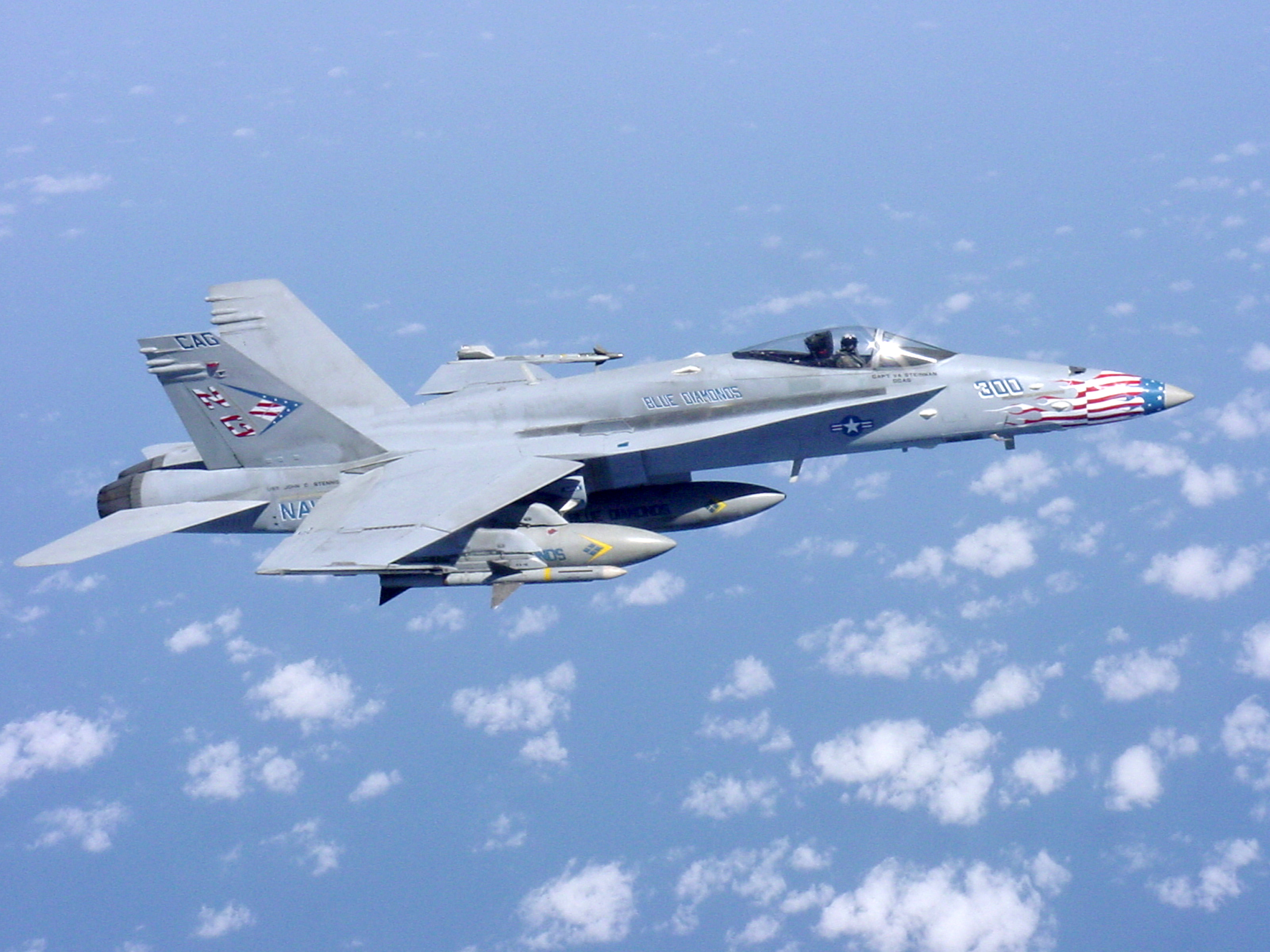
An F/A-18 Hornet of VFA-146 "Blue Diamonds" in flight on a mission during Operation Enduring Freedom. (Photographed by Lt. Kyle "Chet" Turco, United States Navy. Date is unknown. I apologize for any inconvenience.)

Variants of the F/A-18 Hornet are the F/A-18E/F Super Hornet, which is a distinct, and evolutionary upgrade of the Hornet, and the EA-18G Growler, an electronic warfare version of the F/A-18.

The following is a list of countries that currently operates the F/A-18 Hornet.
-U.S.A.
-Australia
-Canada
-Finland
-Spain
-Kuwait
-Switzerland
-Malaysia

The F/A-18 has been criticized for its low range, and payload compared to its comtemporaries.

Specifications...

General characteristics

  • Crew: F/A-18C: 1, F/A-18D: 2 (pilot and weapons system officer)
  • Length: 56 ft (17.1 m)
  • Wingspan: 40 ft (12.3 m)
  • Height: 15 ft 4 in (4.7 m)
  • Wing area: 400 ft² (38 m²)
  • Airfoil: NACA 65A005 mod root, 65A003.5 mod tip
  • Empty weight: 23,000 lb (10,400 kg)
  • Loaded weight: 36,970 lb (16,770 kg)
  • Max takeoff weight: 51,900 lb (23,500 kg)
  • Powerplant: 2× General Electric F404-GE-402 turbofans
  • Dry thrust: 11,000 lbf (48.9 kN) each
  • Thrust with afterburner: 17,750 lbf (79.2 kN) each
  • Performance
  • Maximum speed: Mach 1.8 (1,190 mph, 1,915 km/h) at 40,000 ft (12,190 m)
  • Range: 1,089 nmi (1,250 miles, 2,000 km) with only two AIM-9s
  • Combat radius: 400 nmi (460 mi, 740 km) on air-air mission
  • Ferry range: 1,800 nmi (2,070 mi, 3,330 km)
  • Service ceiling: 50,000 ft (15,240 m)
  • Rate of climb: 50,000 ft/min (254 m/s)
  • Wing loading: 93 lb/ft² (454 kg/m²)
  • Thrust/weight: 0.96

Armament

  • Guns: 1× 20 mm (0.787 in) M61 Vulcan nose mounted 6-barreled gatling cannon, 578 rounds
  • Hardpoints: 9 total: 2× wingtips missile launch rail, 4× under-wing, and 3× under-fuselage with a capacity of 13,700 lb (6,215 kg) external fuel and ordnance

Rockets:

  • 2.75 inches (70 mm) Hydra 70 rockets
  • 5 in (127.0 mm) Zuni rockets
  • Missiles:
  • Air-to-air missiles:
  • AIM-9 Sidewinder or 4× AIM-132 ASRAAM or 4× IRIS-T or 4× AIM-120 AMRAAM, and
  • AIM-7 Sparrow or additional 2× AIM-120 AMRAAM

Air-to-surface missiles:

  • AGM-65 Maverick
  • Standoff Land Attack Missile (SLAM-ER)
  • AGM-88 HARM Anti-radiation missile (ARM)
  • AGM-154 Joint Standoff Weapon (JSOW)
  • Taurus missile (Cruise missile)

Anti-ship missile:

  • AGM-84 Harpoon
Bombs:
  • JDAM Precision-guided munition (PGMs)
  • Paveway series of Laser guided bombs
  • Mk 80 series of unguided iron bombs
  • CBU-87 cluster
  • CBU-89 gator mine
  • CBU-97
  • Mk 20 Rockeye II
  • B61/Mk57 nuclear bombs

Others:

  • SUU-42A/A Flares/Infrared decoys dispenser pod and chaff pod or
  • Electronic countermeasures (ECM) pod or
  • AN/AAS-38 Nite Hawk Targeting pods (US Navy only), to be replaced byAN/ASQ-228 ATFLIR or
  • LITENING targeting pod (USMC, Royal Australian Air Force, Spanish Air Force, and Finnish Air Force only) or
  • up to 3× 330 US gallons (1,200 l; 270 imp gal) Sargent Fletcher drop tanks for ferry flight or extended range/loitering time.

Avionics

  • Hughes APG-73 radar
  • ROVER (Remotely Operated Video Enhanced Receiver) antenna for use by US Navy's F/A-18C strike fighter squadrons

...

Contact

mailwebaviation@gmail.com
Search & Win