 Debut of the first B-1B outside of a hangar in Palmdale, California, 1984. For the full description page, click here.
History...The B-1 was conceived as the
Advanced Manned Strategic Aircraft (AMSA) program circa 1965. AMSA was the last in a series of programs through the 1960s that looked at replacing the B-52 Stratofortress with a multi-role supersonic aircraft capable of long-range bombing and missile launching with nuclear weapons. A series of cancellations led to its service introduction being greatly delayed, until the later half of the 1980s, over twenty years after the program first started.
1. The B-70 Valkyrie
In 1955, the USAF released system requirements for a heavy bomber with the B-52's range and payload capabilities, and the supersonic speed of the B-58, in order to replace both of these bombers by 1965. The initial requirements called for a Mach 0.9 cruise speed with a Mach 2+ dash capability. The designs that met this specification were considered unrealistically large, requiring new hangars to hold them and reinforced runways to launch them.
During the design phase new fuels and techniques evolved that would allow an aircraft with similar range to cruise all the way to its target at high speeds. The Air Force asked for new proposals based on these advances, and this work would eventually lead to the B-70 Valkyrie. The Valkyrie was a large six-engine bomber designed to fly at very high altitudes at Mach 3 to avoid defending interceptors, the only effective anti-bomber weapon at that time. Altitude alone was proving so difficult a problem that Soviet interceptors continued to fail to intercept the Lockheed U-2, running out of fuel before reaching a suitable firing point. Given the speed and altitude of the B-70, the defense would have only a few minutes to respond to an attack, and even small numbers of B-70s attacking simultaneously would ensure that most would fly right by the interceptors, regardless of how much warning time they had.
The introduction of effective anti-aircraft missiles rendered this mode of operation dangerous. Unlike a manned interceptor that maneuvers within a plane while climbing, missiles flew straight up and could reach the B-70s altitude in a few minutes. The only concern became speed; as long as the target did not fly out of range before the missile reached it an attack was possible, and a powerful radar giving the operators some "lead time" could easily solve this problem. This was proven in convincing fashion by the downing of Gary Powers' U-2 in 1960.
2. Redefined Role
In response to the missile threat, military planners switched to low-altitude penetration. By carefully selecting the line of approach to a target, and routing the flight path around known anti-aircraft sites, the radar's line-of-sight operation worked in the bomber's advantage by hiding it from view below the landscape. Aircraft speed became much less important. The targets themselves often had defenses located nearby to prevent this sort of approach all the way in, but stand-off weapons such as cruise missiles and the AGM-69 SRAM provided an attack capability from outside of the defensive missile's range. Low-altitude flight also made the bombers very difficult to detect from aircraft at higher altitudes, including interceptors, as radar systems of that generation could not "look down" due to the clutter that resulted from ground reflections.
Operations at low levels would limit the B-70 to subsonic speed, while dramatically decreasing its range due to much higher fuel requirements. The result would be an aircraft with similar speed but much less range than the B-52 it would have replaced. This was not a purely theoretical issue, this exact problem had actually occurred with the B-58, another high-speed aircraft that was forced into the low-level role to avoid missile defenses. The design had "spent" a lot in gaining medium-range Mach 2 performance, but at low altitudes it had strictly subsonic performance and such dramatically reduced range that it limited the selection of targets that could be assigned to it. The "outdated" B-52 outperformed it, as it would have the B-70.
Unsuited for this new role, the viability of the B-70 as a bomber was questioned. Citing high cost, a growing ICBM force, and poor survivability against missiles, the operational fleet was canceled in 1961 by President John F. Kennedy, and the program was changed to a supersonic research program.
3. AMSA
The first such study was known as the Subsonic Low Altitude Bomber (SLAB), which was completed in 1961. This was followed by the similar Extended Range Strike Aircraft (ERSA), which added a Variable-sweep wing planform, something then very much in vogue in the aviation industry. ERSA envisioned a relatively small aircraft with a 10,000 lb (4,500 kg) load and a range of 8,750 nautical miles (16,200 km), with 2,500 nmi (4,600 km) being flown at low altitudes. In August 1963 the similar Low-Altitude Manned Penetrator (LAMP) design was completed, which called for an aircraft with a 20,000 lb (9,000 kg) load and somewhat shorter range of 7,150 nautical miles (13,200 km).
These all culminated in the October 1963 Advanced Manned Precision Strike System (AMPSS), which led to industry studies at Boeing, General Dynamics, and North American. In mid-1964, the USAF had revised its requirements and retitled the project as Advanced Manned Strategic Aircraft (AMSA), which differed from AMPSS primarily in that it also demanded a high-speed high-altitude capability, albeit slower than the Valkyrie at about Mach 2. Rockwell engineers joked that the new name actually stood for "America's Most Studied Aircraft", given the lengthy series of design studies.
However, the A.M.S>A. project was cancelled by opposition from many high-ranked staff who preferred I.C.B.M. (Intercontinental Ballistic Missile) over long-range bombers.
4. B-1A Program
 The B-1A in flight showing its underside. For the full description page, click here.
President Richard Nixon re-established the program after taking office, in keeping with his flexible response strategy that required a broad range of options short of general nuclear war. Secretary of Defense Melvin Laird reviewed the programs and decided to lower the numbers of FB-111s claiming it lacked the required range, and recommended that the AMSA design studies be accelerated. In April 1969 the program officially became the B-1A. This was the first entry in the new bomber designation series, first created in 1962.
Rockwell's design featured a number of features common to 1960s U.S. designs. These included the use of variable-sweep wings in order to provide both high lift during takeoff and landing, and low drag during a high-speed dash phase. With the wings set to their widest position the aircraft had considerably better lift and power than the B-52, allowing it to operate from a much wider variety of bases. Penetration of the U.S.S.R.'s defenses would take place in a dash, crossing them as quickly as possible before entering into the less defended "heartland" where speeds could be reduced again. The large size and fuel capacity of the design would allow this dash portion of the flight to be relatively long.
In order to achieve the required Mach 2 performance at high altitudes, the air intake inlets were variable. In addition, the exhaust nozzles were fully variable. Initially, it had been expected that a Mach 1.2 performance could be achieved at low altitude, which required that titanium be used in critical areas in the fuselage and wing structure. However, this low altitude performance requirement was lowered to only Mach 0.85, reducing the amount of titanium, and the overall cost.
Overall it had a range similar to that of the B-52, although more of the flight could be low-level. A combination of flying lower due to better navigation systems and a greatly reduced radar cross section made it much safer from attack by missiles, and the latter also improved its odds against fighters as well. In situations where fighters were the expected competition (i.e. outside the USSR), its high-speed dash was a potentially useful technique the B-52 could not match. A convincing B-52 replacement had arrived.
5. Another cancellation
When Carter took office in 1977 he ordered a review of the entire program. By this point the projected cost of the program had risen to over $100 million per aircraft, although this was lifetime cost over 20 years. He was informed of the relatively new work on stealth aircraft that had started in 1975, and decided that this was a far better avenue of approach than the B-1. Pentagon officials also stated that the ALCM launched from the existing B-52 fleet would give the USAF equal capability of penetrating Soviet airspace. With a 1,500 statute mile (2,400 km) range, the ALCM could be launched well outside the range of any Soviet defenses, and penetrate at low altitude just like a bomber, but in much greater numbers. A small number of B-52 operating outside interception range could launch hundreds of ALCMs, saturating the defense. A program to improve the B-52 and develop and deploy the ALCM would cost perhaps 20% of the price to deploy the planned 244 B-1A's.
On June 30th, 1977 Carter announced that the B-1A would be cancelled in favor of ICBMs, SLBMs, and a fleet of modernized B-52s armed with ALCMs. Carter called it "one of the most difficult decisions that I've made since I've been in office." No mention of the stealth work was made public, the program being top secret, but today it is known that he authorized the Advanced Technology Bomber (ATB) project in early 1978, which eventually led to the B-2 Spirit.
Flight tests of the four B-1A prototypes for the B-1A program continued through April 1981. The program included 70 flights totalling 378 hours. A top speed of Mach 2.22 was reached by the second B-1A. Engine testing also continued during this time with the YF101 engines totalling almost 7,600 hours.
6. Shifting priorities
It was during this period that the Soviets, also acting in proxy through Cuba, started to exert themselves in several new theaters of action, in particular the Cuban support in Angola starting in 1975 and the Soviet invasion of Afghanistan in 1979. The U.S. strategy to this point was containment and a conventional and nuclear war in Europe, which almost all military planning had been focused on. These newer actions revealed that the military was simply incapable of supporting any sort of effort outside these narrow confines.
The Army responded by accelerating its Rapid Deployment Force concept, but suffered from major problems with airlift and sealift capability. While gaming a USSR-led invasion of Iran from Afghanistan, then considered (incorrectly) to be a major Soviet goal, it was discovered that only small numbers of units could be in the field in anything close to a week. In order to slow an advance while this happened they relied on air power, but critically the Iran-Afghanistan border was outside the U.S. Navy's range, leaving this role to the Air Force. They, in turn, had limited capability to offer ground support in many areas that were outside of the range of friendly airbases. Although the B-52 had the range to support on-demand global missions, the B-52's long runway requirements dramatically limited the forward basing possibilities. In real-world scenarios the capabilities of this force against any given potential target was limited, something the B-1 would be better prepared to handle due to its better takeoff performance and range.
During the 1980 presidential campaign, Ronald Reagan campaigned heavily on the platform that Carter was weak on defense, using the cancellation of the B-1 program as a prime example, a theme he continued using into the 1980s. During this time Carter's defense secretary, Harold Brown, announced the stealth bomber project, apparently implying that this was the reason for the B-1 cancellation. Brown later denied this claim, stating Carter was simply opposed to any military buildup. Although Reagan's primary attack on Carter's decision was now rendered moot, he immediately changed his complaint saying that Carter was giving away secrets and politicizing The Pentagon, charges that led to a round of sparring between Brown and Reagan in the press. Interestingly, it was Brown that had led the original AMSA program, but later came to prefer the cruise missile after taking the job of Defense Secretary in 1977.
7. B-1B program
On taking office, Reagan was faced with the same decision as Carter before; whether to continue with the B-1 for the short term, or to wait for the development of the ATB, a much more advanced aircraft. He decided to do both. Air Force studies suggested that the existing B-52 fleet with ALCM would remain a credible threat until 1985 , as it was predicted that 75% of the B-52 force would survive to attack its targets. After this period the introduction of the SA-10 missile, MiG-31 interceptor and the first Soviet AWACS systems would make them increasingly vulnerable.
During the FY81 budget funds were given to a new study for a bomber for the 1990s time-frame. These studies led to the Long-Range Combat Aircraft (LRCA) project which compared the B-1, F-111 and ATB as possible solutions. An emphasis was placed on the design being multi-role, as opposed to a purely strategic weapon. At the time it was believed the B-1 could be in operation before the B-2, covering the time period between the B-52s increasing vulnerability and the introduction of the ATB. Reagan decided the best solution was to purchase both the B-1 and ATB, and this eventually led to Reagan's October 2nd, 1981 announcement that a new version of the B-1 was being ordered to fill the LRCA role.
Numerous changes were made to the design to better fit it to real-world missions, resulting in the new B-1B. These changes included a reduction in maximum speed, which allowed the variable-aspect intake ramps to be replaced by simpler fixed geometry intake ramps in the newer design. This made the B version more radar-stealthy because the compressor faces of the engines, major radar reflectors, would be partially hidden. Low-altitude speed was somewhat improved, from about Mach 0.85 to 0.92. This left the B-1B with the capability for speeds of about Mach 1.25 "at altitude," a reduction from the B-1A's Mach 2 performance. In order to deal with the introduction of the MiG-31 and other aircraft with look-down capability, the B-1B's electronic warfare suite was significantly upgraded. These changes, along with the rampant inflation of the U.S. economy during the time, dramatically increased the nominal price to about $200 million total projected lifetime cost per completed airframe.
Opposition to the plan was widespread within Congress. Critics pointed out that many of the original problems with the concept remained. In particular it seemed the B-52 fit with electronics similar to the B-1B would be equally able to avoid interception, as the speed advantage of the B-1 was now minimal. It also appeared that the "interim" time frame served by the B-1B would be less than a decade, being rendered obsolete shortly after introduction by the much more capable ATB design. The primary argument in favor of the B-1 was its large conventional payload, and that its takeoff performance allowed it to operate with a credible bombload from a much wider variety of airfields. The debate remained rancorous. But the Air Force very astutely spread production subcontracts across many congressional districts, making the aircraft more popular on Capitol Hill
.
The first production model of the revised B-1B first flew in October 1984, and the first B-1B, "The Star of Abilene", was delivered to Dyess Air Force Base, Abilene, Texas, in June, 1985, with initial operational capability on October 1st, 1986. The 100th and final B-1B was delivered May 2nd, 1988.
Operational History...The USAF Strategic Air Command (SAC) had B-1 Lancers in service from 1986 through 1992, when SAC was re-organized out of existence. During that time the "Bone" was on limited alert, and the backbone of SAC's alert bombers remained B-52H models. In late 1990 engine fires in two Lancers caused the grounding of the fleet. The cause was traced back to problems in the first-stage fan. Aircraft were placed on "limited alert", meaning they were grounded unless a nuclear war broke out. They were returned to duty one-at-a-time starting in January 1991 as they were inspected and repaired. It was not until mid-April that the fleet was once again declared airworthy.
Originally designed strictly for nuclear war, the B-1's development as an effective conventional bomber was delayed until the 1990s. By 1991, the B-1 had a fledgling conventional capability, forty of them able to drop the 500 lb (230 kg) Mk-82 General Purpose (GP) bomb, although mostly from low altitude. Although cleared for this role, the problems with the engines precluded their use in Operation Desert Storm. Also, B-1s were reserved for strategic nuclear strike missions at this time.
After the absorption of Strategic Air Command (SAC) into Air Combat Command in 1992, the B-1 began to truly develop conventionally. A key part of this development was the start-up of the B-1 Weapons School Division, also in 1992. By the mid-1990s, the B-1 could employ GP weapons as well as various CBUs. By the end of the 1990s, with the advent of the "Block D" upgrade, the B-1 boasted a full array of guided and unguided munitions. This development has continued through the present.
Operationally, the B-1 was first used in combat in support of operations against Iraq during Operation Desert Fox in December 1998, employing unguided GP weapons. B-1s have been subsequently used in Operation Allied Force (Kosovo) and most notably in Operation Enduring Freedom in Afghanistan and the 2003 invasion of Iraq. In both conflicts, the B-1 employed its full array of conventional weapons, most notably the GBU-31, 2,000 lb (900 kg) Joint Direct Attack Munition (JDAM). During OEF, the B-1 improved its mission capable rate to 79%. The B-1 continues to be used in combat to the present day. The most recent addition to its arsenal is the GBU-38, a 500 lb (230 kg) JDAM. The use of the GBU-38 reduces undesired collateral damage and is very useful in urban Close Air Support.
The B-1 now fills an important niche in the Air Force inventory. The project finished on budget, and the B-1 has higher survivability and speed when compared to the older B-52, which it was intended to replace. With the arrival of limited numbers of B-2s in the 1990s and the continuing use of B-52s, its value has been questioned. However, the capability of a high-speed strike with a large bomb payload for time-sensitive operations is useful, and no new strategic bomber is on the immediate horizon.
The B-1 holds several FAI world records for speed, and time-to-climb in different aircraft weight classes. The National Aeronautic Association recognized the B-1B for completing one of the 10 most memorable record flights for 1994.

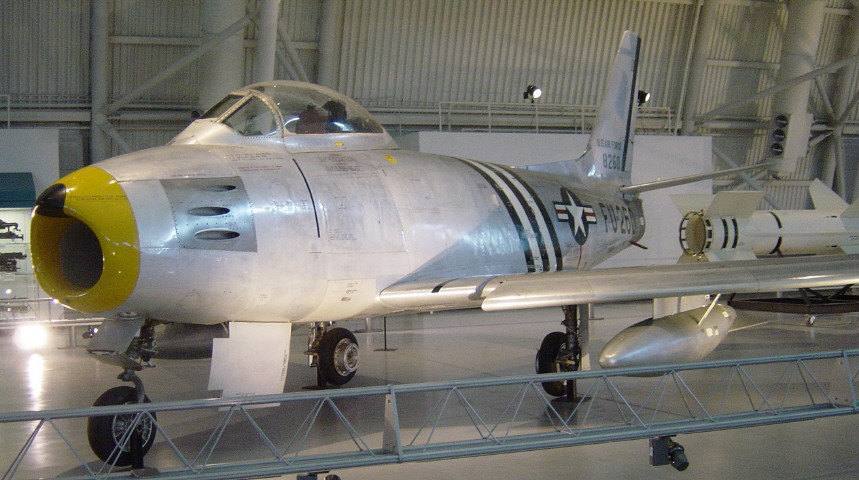 An F-86 Sabre.
 A MiG-15 "Fagot".


