Search this Site

NAVY'S CARRIER-CAPABLE STEALTH UAV - the X-47B


Just a week ago, the Navy test-flew its new UAV, the X-47B. The test flight took place at Edwards AFB at 2 p.m. and lasted 29 minutes. The aircraft reached an altitude of 5 000 ft.

The X-47B is said to revolutionize robotic aerial warfare because of some of its one of a kind characteristics. Unlike other UAV's before it, such as the Predators and Reapers operating in the Middle East, the X-47B is powered by a jet engine so it can fly at much higher speeds. This new UAV also possesses stealth characteristics and will also be able to operate off carriers.

The X-47B's airframe looks like a combination between the B-2 and the F-117. It has a tailless design like the B-2 and the wing design of the F-117. The demonstration aircraft seen above is only a fraction of the size the X-47B will be. The X-47C, a proposed larger version, will have a wingspan of 172 ft, more than 4 times the length of the wingspan of the B variant (which is 38.2 ft).

The funding for this aircraft began in 2007 when the Navy awarded a $ 635.8 million contract to Northrop Grumman. It will be a few more years before the X-47B comes into service but it shows that more and more attention is being paid on unmanned aerial vehicles and that in the future, aerial warfare will probably be predominantly unmanned planes.

A Japanese Stealth Fighter?


Japan has recently announced that it will test fly its own stealth fighter, the Mitsubishi ATD-X, in 2014. This announcement was not a complete surprise as since 2009, it has provided $ 473 million dollars in funding to this program after it became apparent the US will not share its F-22 technology.

The design of the ATD-X is similar to other fourth and fifth generation fighters. It is a single-seater powered by two engines. Right now, there is a 1/3 model of the plane.

Some of the features of the ATD-X include a Fly-By-Optics system where, instead of using wires, the plane uses optical fibres to transfer information. These fibres transfer information at a much higher rate and are immune to electro magnetic disturbances.

The radar of the plane will be an actively electronically scanned array (AESA) radar called the "Multifunction RF Sensor" that is intended to have capabilities such as electronic countermeasures (ECM), electronic support measures (ESM), communications functions, and possibly even microwave weapon functions.

Another feature will be the "Self Repairing Flight Control Capability" that will allow the aircraft to detect failures or damages on its flight control surfaces so that it can use the remaining flight control surfaces to continue flying the plane.

It is interesting to note that just two months ago, China test flew its own stealth fighter, the J-20 and last year, Russia test flew its stealth fighter, the T-50. Currently, the US is the only country that has operational stealth fighters but with so many countries developing their own, this will certainly change in the near future.

China's New Stealth Jet


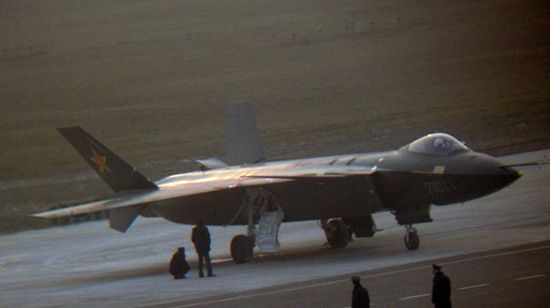
China's new Chengdu J-20 aircraft made its first flight on January 11, 2011. It's a fifth generation stealth fighter similar to the US F-22 and F-35 and Russia's T-50. According to a high-ranking official in the People's Liberation Army Air Force, it is expected this jet will become operational in 2017-2019.

The J-20 is a single-seater aircraft powered by two engines. Design features include low jet intakes, a delta wing, forward canard wings, a bubble canopy, a forward chine, and all-moving fins.

Like the F-22 and T-50, the J-20 can supercruise.

Through preliminary photos, it can be seen that the J-20 is certainly larger in size than both the F-22 and the T-50. This means that the J-20 is probably going to be less maneuverable but it will be able to carry more weapons and fuel. Also, according to an Australian defense analyst, Carlo Kopp that the J-20's stealth shape is "without doubt considerably better" than both those two planes.

It is disappointing to note that some people speculate that the Chinese used technology from the downed F-117 of the Kosovo War to develop the J-20. However, according to Xu YongLing, a Chinese test pilot, the aircraft is a "masterpiece" of homegrown innovation and that the F-117 was already "outdated" at the time it was shot down and would not be practical to apply this technology to a next-generation aircraft.

...

Contact

mailwebaviation@gmail.com
Search & Win